
Male-Factor Infertility and ICSI: A Clinical Decision Framework
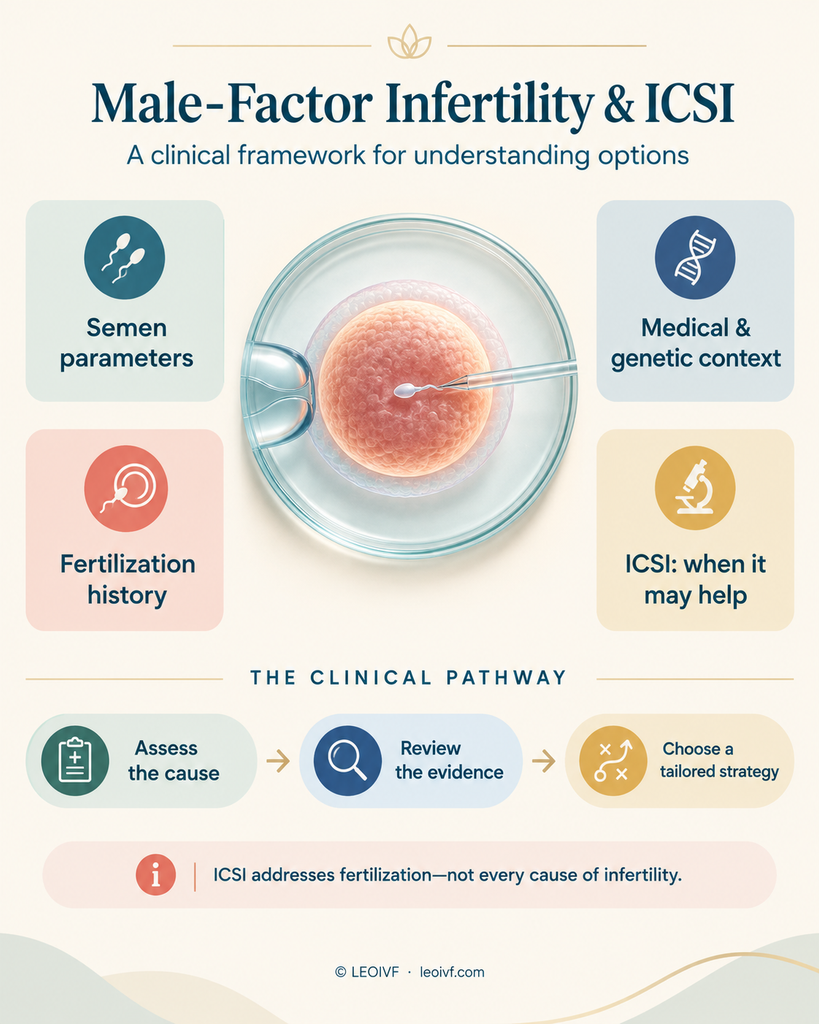
Male-factor infertility means sperm quantity or quality limits natural or IVF conception; ICSI (intracytoplasmic sperm injection) is the technique of placing a single sperm directly into the egg. ICSI is clearly indicated for severe male factor, previous fertilization failure, or surgically retrieved sperm — but for mild male factor or unexplained infertility, routine ICSI is not proven to improve live birth and carries its own considerations. This framework shows when ICSI helps, when it may be unnecessary, and the decision domains involved. General education, not individual medical advice.
What “male factor” covers
- OAT syndrome — oligo- (low count), astheno- (poor motility), terato- (abnormal shape) zoomed together.
- Azoospermia — no sperm in ejaculate; obstructive vs non-obstructive (needs sperm retrieval).
- DNA fragmentation (DFI) — broken sperm DNA missed by standard analysis.
- Genetic — Y-chromosome microdeletions, CFTR (CBAVD), karyotype (e.g., Klinefelter).
A decision-domain framework
| Domain | Question it answers | Typical action |
|---|---|---|
| Severity | How impaired is the sperm? | Mild → IVF may suffice; severe → ICSI |
| Fertilization history | Did prior IVF fertilize? | Failure → ICSI |
| Sperm retrieval need | Is ejaculated sperm absent? | TESE/PESA/Micro-TESE |
| DFI | Is DNA damage high? | Sperm selection (PICSI/Zymot) |
| Genetics / counseling | Inheritable cause? | Karyotype, Y-del, CFTR |
Why the framework matters
- It prevents overuse of ICSI where conventional IVF would work.
- It ensures underuse is avoided in severe cases and azoospermia.
- It flags genetic counseling that protects the next generation.
What male-factor work-up can and cannot tell you
- Can suggest: which technique (IVF vs ICSI), whether retrieval is needed, and genetic risks.
- Cannot prove: that ICSI guarantees fertilization or pregnancy; sperm quality is one of several variables.
Related reading
- Build your pre-cycle review: Male-Factor Infertility: What to Review Before Your ICSI Cycle
- Read your work-up: How to Read a Male-Factor Work-Up and ICSI Plan
- What the evidence shows: Male-Factor Infertility and ICSI: What the Evidence Can—and Cannot—Tell You
- DFI decision: Could Sperm DNA Fragmentation Mean You Should Use ICSI, PICSI, or Zymot?
Cross-cluster context
- Sperm DFI also drives day-3 arrest (day-3 hub): Could Sperm DNA Fragmentation Affect Embryo Development After Day 3?
- And RIF (RIF hub): Could Sperm Quality or DNA Fragmentation Cause RIF?
- And poor blastocyst development (PBD hub): Could Sperm DNA Fragmentation Cause Poor Blastocyst Development?
Your next step
Map your sperm parameters to a technique with the IVF Case Clarity Assessment.
Medical disclaimer
General education only; not individual medical advice. Male-factor testing, ICSI, and genetics are managed with a reproductive specialist or andrologist.
References
- Practice Committee of ASRM. Intracytoplasmic sperm injection (ICSI): a committee opinion. Fertil Steril. (updated).
- ESHRE Guideline Group on Male Infertility. ESHRE guideline: male infertility. Hum Reprod Open. 2024.
- Agarwal A, et al. Sperm DNA fragmentation: a review. Transl Androl Urol. 2023.
- Krausz C, et al. Y-chromosome microdeletions and male infertility. Semin Med Genet. (Y-del research).