
Poor Ovarian Response: What to Review Before Your Next IVF Cycle
Before another stimulation after a low egg yield, the highest-value move is a structured review of your reserve tests and exactly how the last cycle was run — not guessing. The checklist below organizes the evidence-based work-up into labs, stimulation details, and modifiable factors, so a genuinely low reserve is distinguished from a cycle that was simply under-stimulated. A low count is informative; a pattern across cycles is decisive. General education, not individual medical advice.
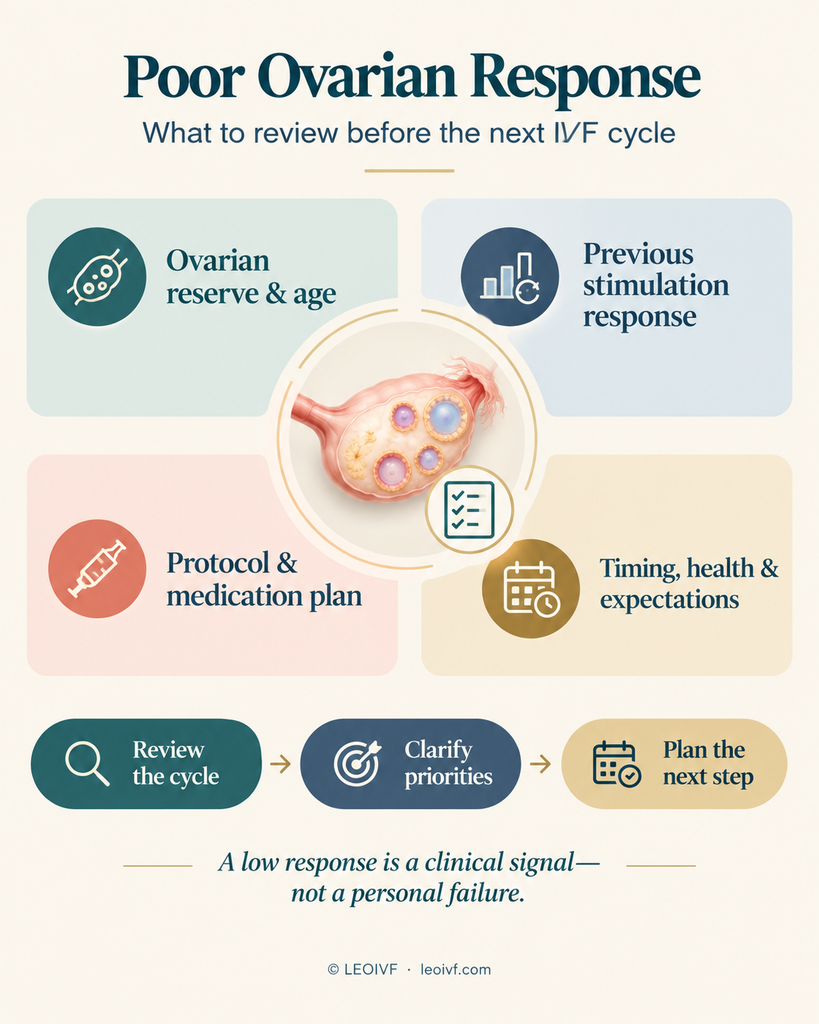
The six-step pre-cycle review
- Ovarian reserve labs — AMH, antral follicle count (AFC), day-3 FSH and estradiol (E2). These define your baseline “tank.”
- Prior stimulation details — protocol (antagonist/agonist), total gonadotropin dose, days of stimulation, trigger type, and number of oocytes retrieved.
- Age and POSEIDON subgroup — young with normal reserve but low yield = “unexpected” (protocol may help); older with low AMH = “expected” (donor discussion earlier).
- Secondary causes — endometrioma or ovarian surgery history, FMR1 (fragile X) testing if indicated, thyroid/autoimmune screen.
- Adjuvants tried — androgens (DHEA/testosterone), CoQ10, growth hormone; were any used, and was there a response?
- Cumulative outcomes — number of euploid embryos across all cycles; if persistently zero, raise donor-oocyte counseling.
Test → why → evidence
| Review item | Why it matters | Evidence strength |
|---|---|---|
| AMH + AFC | Best static reserve markers | High |
| Day-3 FSH/E2 | Confirms reserve, flags pituitary signal | Moderate–High |
| Stimulation log | Catches under-dosing / wrong trigger | High (actionable) |
| POSEIDON grouping | Guides protocol vs donor path | Moderate |
| FMR1 / surgery history | Identifies secondary cause | Moderate (selected) |
| Adjuvant history | Avoids repeating a failed add-on | Moderate |
What this review can and cannot do
- Can: separate expected from unexpected poor response and stop low-value repetition.
- Cannot: create more eggs than your reserve allows; it redirects strategy, not biology.
Related reading
- The framework: What Is Poor Ovarian Response?
- Read your labs: How to Read Your Ovarian Reserve Tests (AMH, AFC, FSH)
- One cycle vs pattern: Poor Ovarian Response and Low Egg Count: What One Cycle Can—and Cannot—Tell You
- Treatment decisions: Should You Change Your Stimulation Protocol After a Poor Ovarian Response?
Your next step
Turn your labs and last cycle into a checked/unchecked list with the IVF Case Clarity Assessment.
Medical disclaimer
General education only; not individual medical advice. Testing and treatment are decisions made with your reproductive specialist.
References
- ESHRE working group on poor ovarian response. ESHRE consensus on the definition of poor ovarian response: the Bologna criteria. Hum Reprod. 2011;26(7):1616–1624.
- The POSEIDON group. A new more detailed stratification of low responders to ovarian stimulation. Hum Reprod Open. 2016.
- Practice Committee of ASRM. Fertility evaluation of infertile women: a committee opinion. Fertil Steril. 2020/2021.
- Cimadomo D, et al. Clinical relevance of maternal age on oocyte and embryo competence. Front Endocrinol. 2022.