
What Is a Failed Euploid Embryo Transfer? A Clinical Review Framework
A failed euploid embryo transfer means a chromosomally normal (PGT-A–tested) embryo was placed in the uterus but did not result in a pregnancy. It is a specific, common scenario: after two or three such failures, the problem shifts away from embryo chromosomes toward the endometrium and other receptivity factors. Importantly, “euploid” sharply lowers — but does not eliminate — the chance of failure. This framework shows why a normal embryo can still not implant, and where to look next. General education, not individual medical advice.
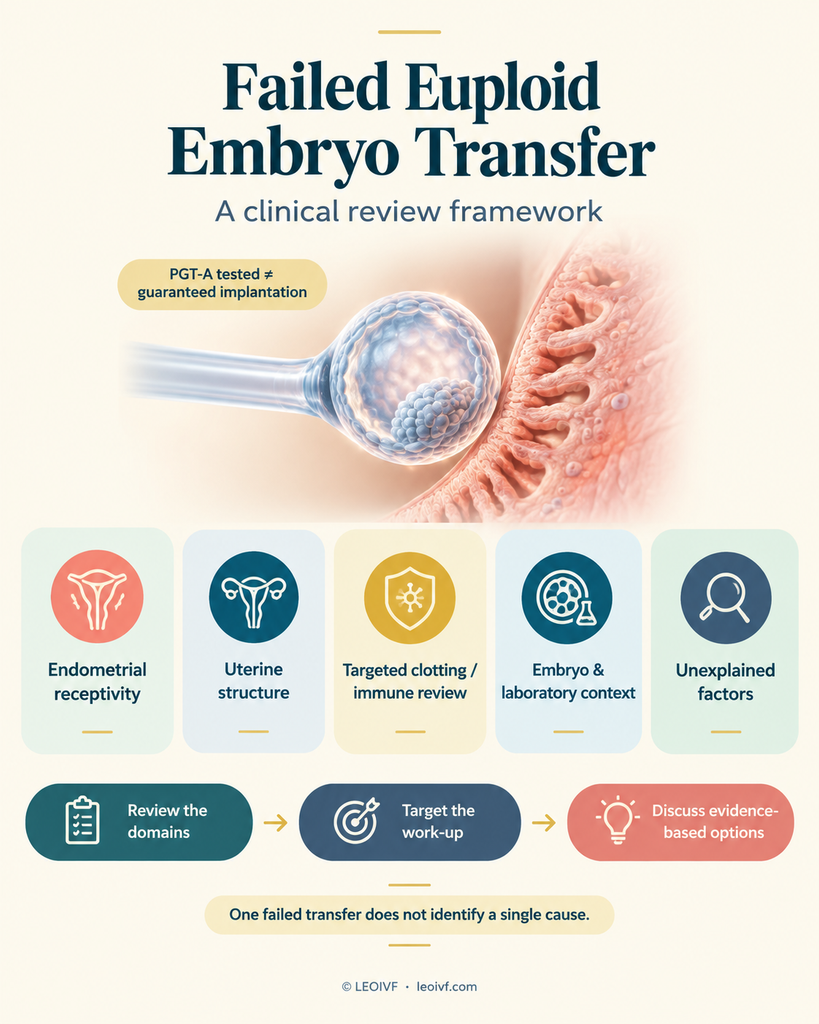
Why “euploid” is not a guarantee
PGT-A rules out the common chromosome errors that cause most failures, but it does not test everything: mitochondrial function, subtle rearrangement, endometrial receptivity, and uterine structure all still matter. So a euploid embryo failing is frequent enough to have its own work-up.
A five-domain framework
| Domain | What can go wrong | Typical signal |
|---|---|---|
| Endometrial receptivity | Timing/window, chronic endometritis | Normal embryo, no implantation |
| Uterine structure | Polyps, fibroids, hydrosalpinx, adhesions | Imaging abnormality |
| Thrombophilia / immune | APS, clotting, contested immune factors | Personal/family history; mostly unproven |
| Embryo re-segmentation / lab | Mosaic re-diploidization, biopsy/vitrification effects | Rare; lab-specific |
| Unexplained | No found cause after full work-up | Normal everything |
Why the framework matters
- With a screened embryo, the endometrium becomes the prime suspect — not the egg.
- Uterine structure is fixable and must be ruled out.
- Thrombophilia/immune testing should be targeted, not blanket.
What a failed euploid transfer can and cannot tell you
- Can suggest: where to redirect the work-up (receptivity, structure, clotting history).
- Cannot prove: that the embryo was “bad,” or that any single test will fix it — many stay unexplained.
Related reading
- Build your pre-transfer review: Failed Euploid Embryo Transfer: What to Review Before Your Next Transfer
- Read your PGT-A report: How to Read Your PGT-A and Transfer Report When a Euploid Embryo Doesn’t Implant
- The endometrium angle: Could Endometrial Receptivity or Chronic Endometritis Explain a Failed Euploid Transfer?
- Treatment decisions: Should You Change Your Transfer Protocol After a Failed Euploid Embryo Transfer?
Cross-cluster context
- Failed euploid → recurrent implantation failure (RIF hub): What Is Recurrent Implantation Failure?
- No euploid to transfer often starts with low yield (POR hub): What Is Poor Ovarian Response?
- Or poor blastocyst development (PBD hub): What Is Poor Blastocyst Development?
Your next step
Map your euploid failures to a domain with the IVF Case Clarity Assessment.
Medical disclaimer
General education only; not individual medical advice. Your specialist remains the decision-maker for testing and treatment.
References
- Practice Committee of ASRM. Preimplantation genetic testing: a committee opinion. Fertil Steril. 2024.
- ESHRE Guideline Group on RPL. ESHRE guideline: recurrent pregnancy loss. Hum Reprod Open. 2024.
- Coughlan C, et al. Recurrent implantation failure: definition and management. Reprod Biomed Online. 2014;28(1):14–38.
- Cimadomo D, et al. Chromosomal mosaicism in preimplantation blastocysts. Hum Reprod. 2021.