
What Is Poor Blastocyst Development? A Clinical Review Framework
Poor blastocyst development means embryos fertilize and often reach day 3, but then fail to form a blastocyst — the day 5–6 cavity stage required for the highest pregnancy potential. The usual arrest window is the compaction-to-blastocyst transition (roughly day 3–5); normally about 40–60% of fertilized eggs reach blastocyst. When that rate is low or zero, the question is why, and the answers fall into distinct domains. This framework helps you and your clinic localize the problem. General education, not individual medical advice.
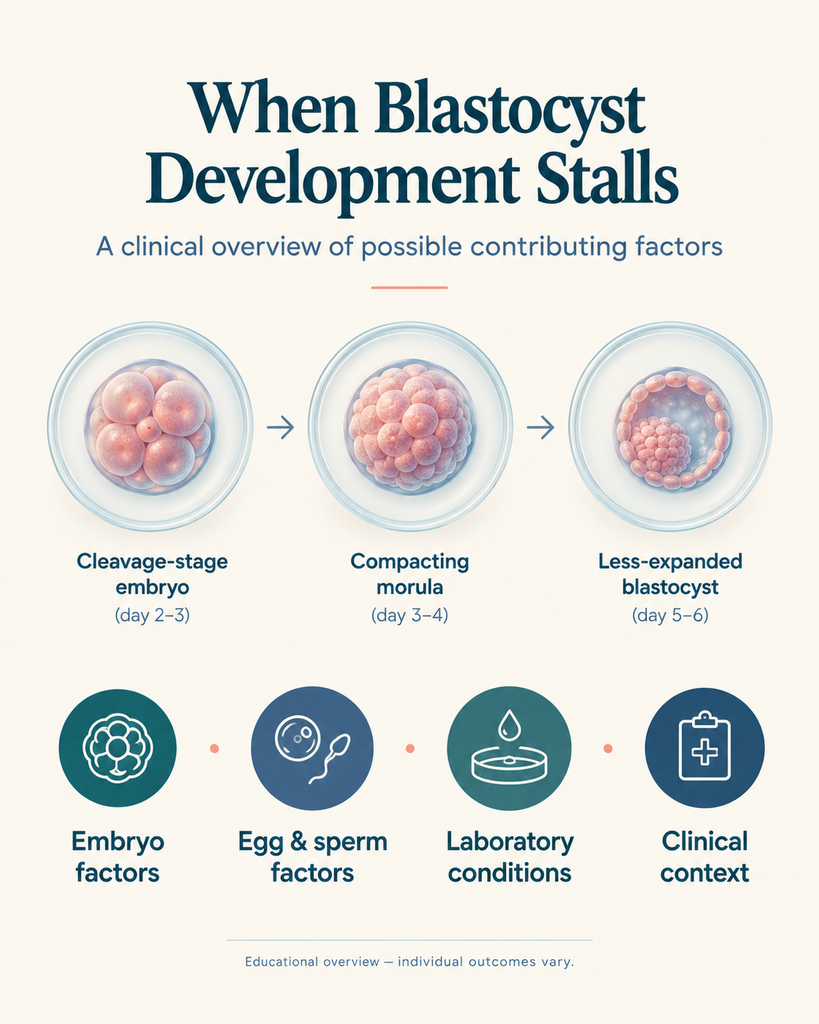
How it differs from day-3 arrest
Day-3 arrest is a cleavage-stage stop; poor blastocyst development is failure to reach the blastocyst stage specifically. They overlap, but “poor blastocyst development” centers the later, blastocyst-stage failure — useful when fertilization looked fine but nothing made it to day 5–6.
A four-domain framework
| Domain | What can go wrong | Typical signal |
|---|---|---|
| Embryo chromosome | Aneuploidy (most common; rises with age) | Few/no blastocysts despite good day-3 grades |
| Oocyte competence | Mitochondrial / cytoplasmic maturity | Age-related; poor blastulation pattern |
| Sperm factors | DNA fragmentation, morphology | Good eggs, yet arrest; DFI untested |
| Culture / lab | Media, gas, temperature, embryologist | Clinic-wide or cycle-specific pattern |
Why the framework matters
- Chromosome / oocyte point to egg-related competence and age; PGT-A and donor discussion may enter.
- Sperm is a modifiable, often-untested factor (DFI).
- Culture/lab is the clinic’s domain — worth a second-opinion or embryologist review when the pattern is unusual.
What poor blastocyst development can and cannot tell you
- Can suggest: which domain to investigate (chromosome vs sperm vs lab).
- Cannot prove: a single cause from one cycle, or that the embryo was definitely aneuploid without testing.
Related reading
- Build your pre-cycle review: Poor Blastocyst Development: What to Review Before Your Next IVF Cycle
- Read your report: How to Read Your Embryology Report When Few or No Embryos Reach Blastocyst
- Egg quality vs one cycle: Poor Blastocyst Development and Egg Quality: What One Cycle Can—and Cannot—Tell You
- Male side: Could Sperm DNA Fragmentation Cause Poor Blastocyst Development?
Cross-cluster context
- Overlap with day-3 hub: Why Do Embryos Stop Developing on Day 3? and How to Read an IVF Embryology Report
- Few blastocysts → fewer to transfer (RIF hub): What Is Recurrent Implantation Failure?
- Low yield source (POR hub): What Is Poor Ovarian Response?
Your next step
Map your blastulation pattern to a domain with the IVF Case Clarity Assessment.
Medical disclaimer
General education only; not individual medical advice. Your specialist remains the decision-maker for testing and treatment.
References
- Alpha Scientists in Reproductive Medicine and ESHRE. The Istanbul consensus workshop on embryo assessment. Hum Reprod. 2011;26(6):1270–1283.
- Gardner DK, et al. Blastocyst culture and transfer. Textbook of Assisted Reproductive Techniques.
- Franasiak JM, et al. The nature of aneuploidy with specific focus on “embryo arrest.” Fertil Steril. 2014/2015.
- Cimadomo D, et al. Clinical relevance of maternal age on oocyte and embryo competence. Front Endocrinol. 2022.