
What Is Recurrent Implantation Failure? A Clinical Review Framework
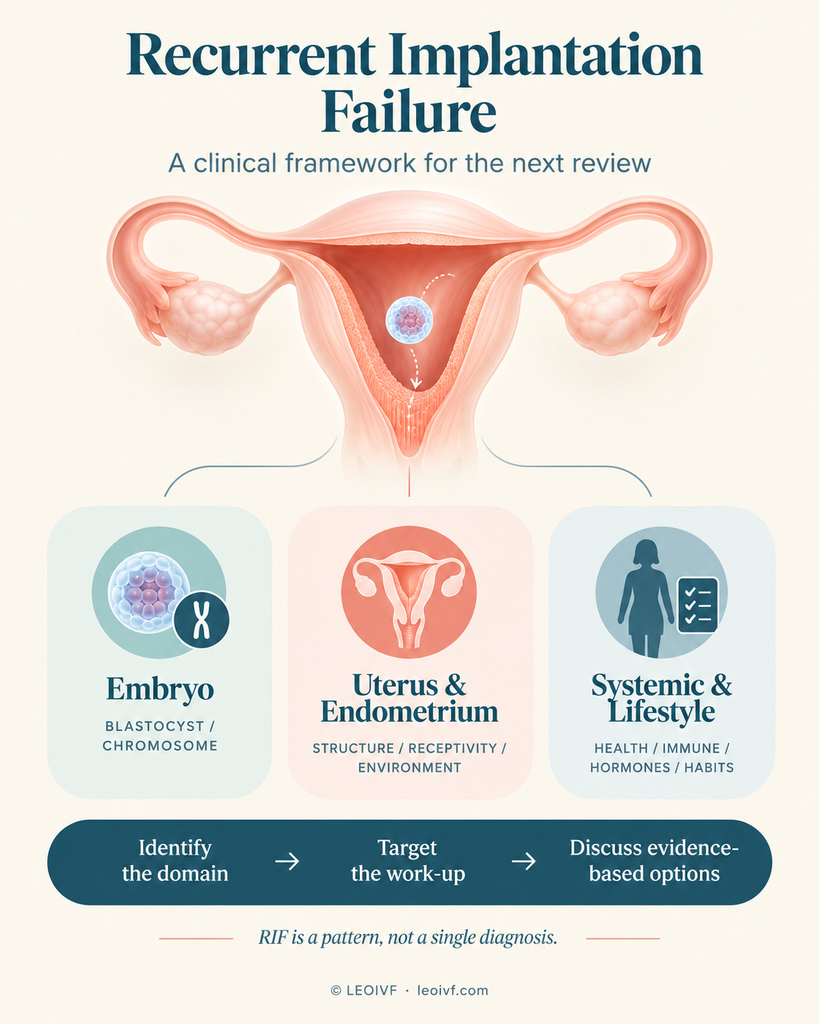
Recurrent implantation failure (RIF) means a competent embryo repeatedly fails to attach and establish a pregnancy. A common working definition is the failure to achieve a clinical pregnancy after transferring good-quality embryos across at least three IVF/ICSI cycles — often cited as 10 or more good embryos — in a woman under 40 (Coughlan et al., 2014). The key point: the problem is at the implantation stage, not (necessarily) embryo development. RIF is sorted into embryo, uterine/endometrial, and systemic domains, each pointing to different next steps. This article gives a framework for which domain likely applies to you. General education, not individual medical advice.
The definition you’ll hear
RIF is not one disease; it is a label for a pattern. Clinics use slightly different cutoffs, but the most cited working definition (Coughlan et al., 2014) is: failure to achieve a clinical pregnancy after transfer of at least 10 good-quality embryos (or ≥4 good embryos per cycle) across ≥3 consecutive IVF/ICSI cycles in women under 40. Some use “three failed transfers with good-quality blastocysts.” Whatever the number, the defining feature is good embryos that don’t take.
A few failed transfers with poor-quality embryos is not RIF — that is an embryo-competence problem (see the day-3 arrest cluster).
A three-domain framework
| Domain | What can go wrong | Typical signal |
|---|---|---|
| Embryo | Chromosome abnormality (aneuploidy), sperm DNA damage, culture effects | Good grade but repeatedly fails; often age-related |
| Uterine / endometrial | Polyps, submucosal fibroids, septum, adhesions, thin lining, hydrosalpinx, chronic endometritis | Cavity or lining abnormality on imaging |
| Systemic / other | Thrombophilia, immune factors (contested), BMI/smoking, unexplained | Normal cavity + normal embryos, no clear cause |
Why the framework matters
Each domain points to a different work-up:
– Embryo → consider PGT-A, sperm DNA fragmentation testing, donor gametes if recurrent aneuploidy.
– Uterine → sonohysterography / hysteroscopy, treat polyps/fibroids, optimize lining, address hydrosalpinx.
– Systemic → evidence-based tests only; avoid unproven “immune” panels used outside guidelines.
What RIF can and cannot tell you
- Can suggest: which body system to investigate next, and which tests are worth doing.
- Cannot prove: a single cause, or that any one test will fix it. Many RIF cases stay “unexplained” even after a full work-up.
Related reading
- Build your pre-transfer review: Recurrent Implantation Failure: What to Review Before Your Next Transfer
- The “unexplained” trap: RIF and Unexplained: What the Evidence Can—and Cannot—Tell You
- Male side: Could Sperm Quality or DNA Fragmentation Cause RIF?
- Treatment decisions: Should You Change Your Transfer Protocol After RIF?
Your next step
Overwhelmed by where to start? The IVF Case Clarity Assessment maps your failed-transfer history onto this framework so your next consult is targeted.
Medical disclaimer
General education only; not individual medical advice. Your specialist remains the decision-maker for testing and treatment.
References
- Coughlan C, et al. Recurrent implantation failure: definition and management. Reprod Biomed Online. 2014;28(1):14–38.
- Practice Committee of ASRM. Preimplantation genetic testing: a committee opinion. Fertil Steril. 2024.
- Practice Committee of ASRM. Role of immunotherapy in in vitro fertilization: a committee opinion. Fertil Steril. 2018 (updated).
- Simon A, Laufer N. Assessment and treatment of repeated implantation failure following IVF-ET. Hum Reprod Update. 2012.