
Should You Change Your IVF Protocol After No Blastocyst Cycle?
After embryos fail to reach blastocyst, changing the protocol is tempting — but, as with other failed cycles, it should follow from which domain your pattern implicates. A chromosome-driven arrest won’t be fixed by a new drug; a sperm or lab issue might be. This framework matches the evidence-based options to your specific blastulation pattern. General education, not individual medical advice.
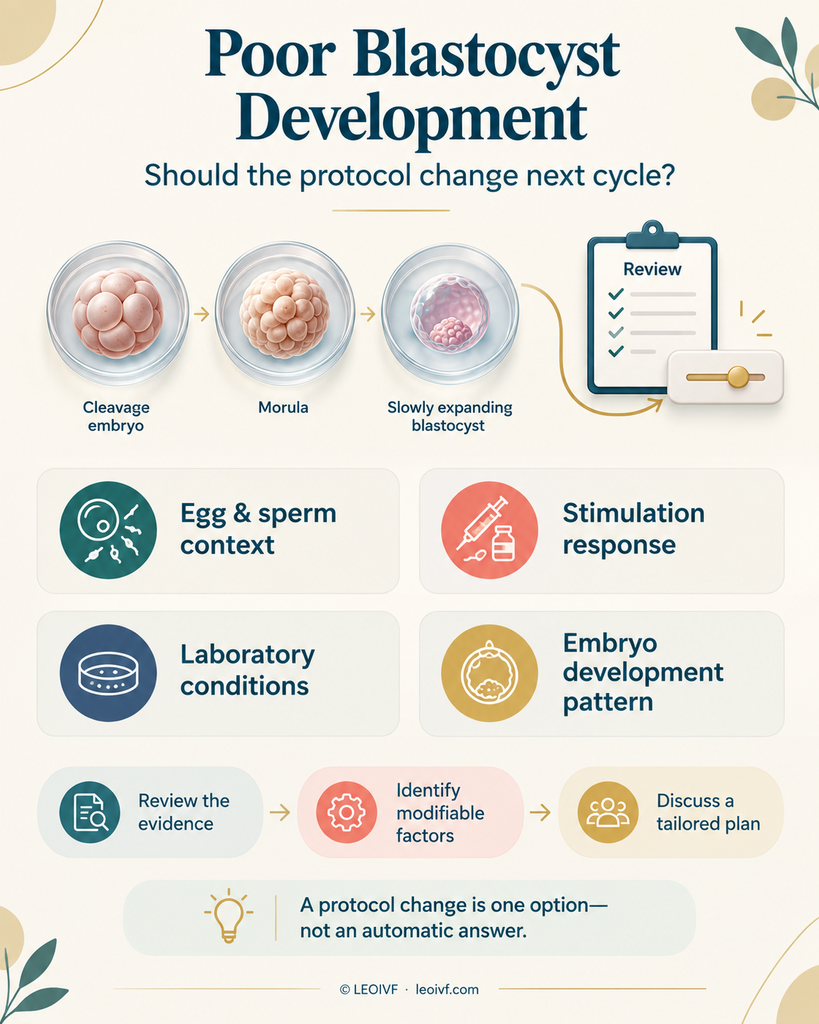
A decision framework
Step 1 — Localize the problem:
– Normal fertilization, arrest day 3–4, no blastocyst → embryo chromosome / oocyte competence (protocol has limited power).
– Low fertilization → sperm–egg interaction (consider ICSI / sperm selection).
– Unusual, clinic-wide pattern → culture/lab variable (not your biology).
Step 2 — Match the option.
| If the pattern is… | Option with the best rationale | Evidence note |
|---|---|---|
| Recurrent aneuploidy / advanced age | PGT-A to select euploid; discuss donor oocytes | Evidence-based for selection |
| Good eggs, arrest, DFI high | Sperm selection (PICSI/Zymot); treat DFI | Reasonable, modifiable |
| Low fertilization | ICSI if not done | Strong when indicated |
| Suspected lab/culture | Embryologist review; second opinion | Case-specific |
| Solo poor cycle | Repeat before changing | Stochastic cycles are real |
| Adjunct interest | CoQ10, growth hormone | Mixed; not guaranteed |
What the evidence does — and doesn’t — support
- Strongest: ICSI when fertilization fails; PGT-A for selecting euploid embryos; sperm selection when DFI is high.
- Weaker / variable: “booster” supplements and growth hormone — help some subgroups, not all.
- Not supported: changing stimulation drugs at random hoping blastulation “improves” when the driver is embryo aneuploidy.
What a protocol change can and cannot do
- Can: address fertilization failure, sperm factors, and (sometimes) culture issues.
- Cannot: repair an already-aneuploid embryo or guarantee a blastocyst; if competence is the dominant issue, PGT-A or donor oocytes — not a drug — are the honest options.
Related reading
- The framework: What Is Poor Blastocyst Development?
- Build the review: What to Review Before Your Next IVF Cycle
- Read your report: How to Read Your Embryology Report When Few or No Embryos Reach Blastocyst
- Male side: Could Sperm DNA Fragmentation Cause Poor Blastocyst Development?
Your next step
Not sure a change is justified? The IVF Case Clarity Assessment lines up your blastulation pattern with the options worth raising.
Medical disclaimer
General education only; not individual medical advice. Protocol changes, medications, PGT-A, and ICSI are decisions made with your reproductive specialist.
References
- Practice Committee of ASRM. Preimplantation genetic testing: a committee opinion. Fertil Steril. 2024.
- Franasiak JM, et al. The nature of aneuploidy with specific focus on “embryo arrest.” Fertil Steril. 2014/2015.
- Alpha Scientists in Reproductive Medicine and ESHRE. The Istanbul consensus workshop on embryo assessment. Hum Reprod. 2011;26(6):1270–1283.